
Digging into the past, one Snoopy collectible at a time
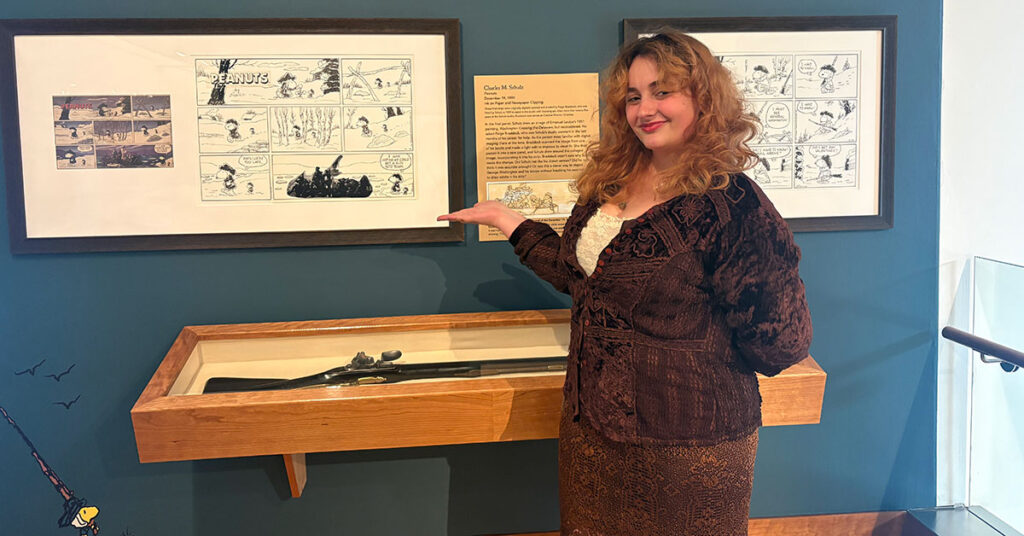
Sid Chapin drew on skills developed at Wheaton for an internship where she gained hands-on research experience and clarified her interest in a museum career.
When Sid Chapin ’27 began opening boxes at the Charles M. Schulz Museum and Research Center, she did not know what she would find.
The 44 boxes contained 1,150 objects that had yet to be inventoried—from wooden Snoopy cars and yo-yos manufactured in the 1970s to crystal figurines and product samples that never reached the market.
“My job was to go through, create a detailed inventory sheet, do research and then put the information into our database,” said Chapin, a double major in European history and visual art.
By the end of the summer, she had inventoried all the objects, conducted research into 500 items and cataloged 60 for inclusion in the museum’s permanent collection.
“I’ve become a lot more prolific with my ability to research,” she said. “Wheaton has definitely taught me a lot of what I needed to know, but getting to apply those skills in the workforce has sharpened them.”
Applying initiative and course work
The museum in Santa Rosa, Calif., which preserves and interprets the work of “Peanuts” creator, did not have an established internship program, but Chapin connected directly with the head of collections, and the two worked out an internship.
“I am the first intern that the Schulz Museum had, and I was able to get that because I took the initiative to make a phone call and ask,” Chapin said. “That really opened my eyes to the fact that there’s just a lot more that’s out there than what’s listed.”
She found that her Wheaton coursework provided just the right background. Chapin took “Introduction to Museum Studies” with Leah Niederstadt, associate professor of museum studies and art history and curator of Wheaton’s Permanent Collection.
While tracing the ownership history of objects in Wheaton’s collection for class, she learned to look beyond the most readily available information.
“Sometimes you have a habit to see the surface and think, ‘Well, there’s nothing there,’” she said. “But really continuously diving down deeper and deeper, you will eventually stumble across exactly what you’re looking for.”
That persistence proved particularly useful during Chapin’s internship, when she encountered products from other countries. Merchandise that never made it to market, for example, could not always be identified through a basic internet search. Finding reliable information required following clues and trying multiple approaches.
From inventory to exhibition
Beyond cataloging, Chapin helped install “Inking History,” an exhibition exploring Schulz’s fascination with the American Revolution and the comic strips it inspired. She observed and assisted museum staff to prepare and install a borrowed musket and bayonet, including building a support to display the objects safely.
The process introduced her to condition reporting—the careful documentation of an object’s state when it arrives at a museum and before it is returned to its owner.
“We took about an hour to note down every scratch or every piece of rust on the musket and bayonet that we can update when we send it back,” she said.
The museum follows a similar painstaking methodology in cataloging the objects in its permanent collection.
“Every part of the process has a different formula,” she said. “That really helps you to understand the item, understand its place in the collections department and create a full scope of every item that we have.”
Making connections
The internship reinforced Chapin’s interest in museum work while giving her the opportunity to apply skills developed at Wheaton in a professional setting.
“Wheaton has definitely taught me a lot of what I need to know, but actually getting to apply those skills in the workforce has definitely helped to really hone that skill,” she said.
A Wheaton summer internship grant made it possible. Chapin, who grew up in Sonoma, Calif., commuted about an hour each way to the museum. The grant helped cover transportation costs and allowed her to devote more time to the internship rather than taking a second job.
“Just having that flexibility made it possible,” she said.
As she begins her senior year, Chapin plans to continue exploring museum careers and make greater use of Wheaton’s career resources and alumni network. She also will serve as a campus tour guide—a role that will provide a more public-facing complement to the often solitary work of collections research.
“This was a very foundational experience,” Chapin said. “I made so many connections, and I learned so much about the museum field and different opportunities within it that I wouldn’t have been able to know if I didn’t take a chance and try.”