Physics
Chair: John Michael Collins
Department home page: http://www.wheatoncollege.edu/acad/physics/
The Wheaton Physics/Astronomy Department provides students with an outstanding individualized curriculum that challenges them to become involved in every stage of the experimental process, from the design of the experiment through the interpretation of data. The mark of a Wheaton physics education is to complement rigorous course work with substantive experiences that call for students at all levels to confront uncertainty in an experiment, and to make rational and informed decisions as to how to probe nature's ways.
Capstone Experience
All majors in their junior or senior year are required to participate in a research project for one semester or for a summer. Each student is required to write a report and give an oral presentation on the project.
Major in physics
Print a major planning worksheet
The major in physics consists of a minimum of 11 semester physics courses, as outlined below, chosen in consultation with members of the department so as to form a coherent program in support of the student's interests and goals.
Required courses
Phys 170 OR Phys 180 Introductory Physics I (Enhanced)
Phys 171 OR Phys 181 Introductory Physics II (Enhanced)
Phys 225 Modern Physics
Phys 298 Modern Physics II
Phys 350 Experimental Physics
At least three of the following four core courses. Students planning to attend graduate school in physics or astronomy should take all four of the courses below.
Phys 310 Statistical and Thermal Physics
Phys 311 Classical Mechanics
Phys 314 Electric and Magnetic Fields
Phys 370 Quantum Mechanics
Two or more of the following courses:
Phys 110 Electronic Circuits
Phys 226 Optics
Phys 227 Remote Sensing
Ast 302 Astrophysics
Phys 360 Geophysics
Phys 398 Mathematical Physics
Phys 398 Computational Physics
Phys 398 Electric and Magnetic Fields II
Mathematics requirement
Math 236 Multivariable Calculus
Recommended courses outside the department
Math 221 (Linear Algebra) and Math 212 (Differential Equations) are highly recommended for students planning on pursuing graduate school in physics, astronomy, engineering, or related fields.
We also recommend that students take a course in computer programming, such as Comp 115.
Major in Astronomy and Physics
Print a major planning worksheet
This interdisciplinary major, requiring at least 10 courses, provides an opportunity for students to pursue their interest in astronomy at a deeper level than is possible through the minor in astronomy by taking courses in physics that provide additional perspective on the fundamental principles underlying astronomical research. This major is not recommended for students planning to do graduate work in astronomy; such students should major in physics.
Required courses
Ast 130 The Universe
Ast 140 The Solar System
Ast 202 Frontiers of Astronomy
Ast 250 Ancient Astronomies
Ast 302 Astrophysics
Ast 305 Observational Astronomy
Phys 170 Introductory Physics I
and/or Phys 171 Introductory Physics II
Phys 225 Modern Physics
Phys 350 Experimental Physics
and an additional 300-level course or Phys 399 Selected Topics
Physics and Engineering--Dual Degree
Students who are interested in using physics as a base to pursue an engineering career should consider participating in a Wheaton dual-degree program in engineering. This program allows students completing three years at Wheaton and two or more additional years at another institution to earn a bachelor of arts degree from Wheaton and a bachelor's degree in engineering.
Departmental honors
Departmental honors will be awarded to students who successfully complete the Senior Honors Thesis and have an average of B+ or better in the major and an average of B or better overall.
Minor in Physics
Print a minor planning worksheet
The minor in physics consists of a minimum of five courses, including Phys 225 and Phys 350, chosen in consultation with members of the department.
Minor in Astronomy
The minor in astronomy consists of Ast 130, Ast 140, Ast 202, Ast 250 and Ast 302 or Ast 305.
Courses
107. The Physics of Music and Sound
For students of music and others. What sound is, how sounds combine, the distinctions between musical and nonmusical sound, the characteristics of sounds produced by different instruments, sound recording and reproduction, and human perception of sound. Includes lecture demonstration.
(John Michael Collins)
Connections:
Conx 20043 Music: The Medium and the Message
110. Electronic Circuits
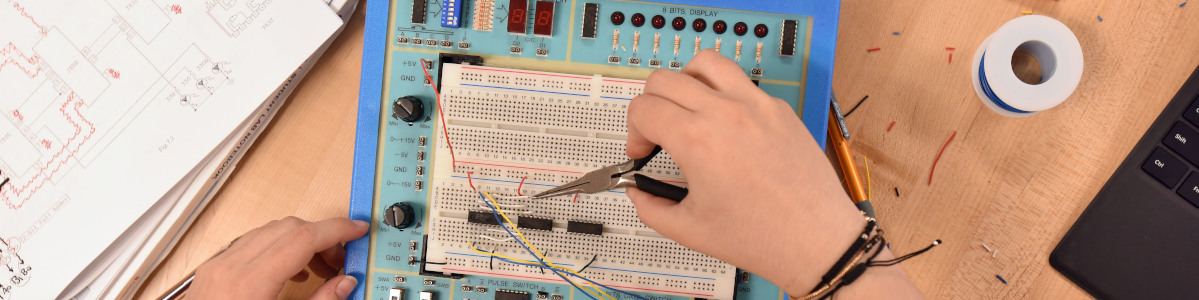
A laboratory-oriented introduction to modern electronics, which progresses from simple circuits using discrete solid-state components to those using integrated circuits common to computers and control devices. Students will gain insight into the way computers work and learn how to use microcomputers to control simple devices. No previous work in physics or electronics is required.
(Xuesheng Chen)
Connections:
Conx 20003 Logic and Digital Circuits
Conx 20022 Computer Architecture
130. The Universe
Properties of stars and how they are born and die; black holes, galaxies, quasars and the origin and evolution of the universe. Weekly two-hour laboratories retrace the steps involved in measuring the age and size of the universe, with enrichment laboratories in astronomical photography and observing.
(Timothy Barker)
Connections:
Conx 20059 Quantum Theories: Contemporary American Fiction, Modern Physics and the Universe
140. The Solar System
The processes that shape the surfaces and atmospheres of planets and satellites and how the planets have evolved in different directions. Students will learn how planetary data are gathered and how to interpret those data and will design a mission to address one of the many remaining mysteries of the solar system.
(Geoffrey Collins, Timothy Barker)
160. Geology
The origin, evolution and behavior of the Earth, the processes that shape the Earth today and investigation of the geologic record to see how these processes have operated in the past. Topics include earthquakes, volcanoes, erosion, rocks and minerals, the interior of the Earth, Earth history and plate tectonics. Laboratories and field trips to investigate local geology are included.
(Geoffrey Collins)
Connections:
Conx 20030 Politics and Global Change
170. Introductory Physics I
The principles of Newtonian mechanics as applied to solids, liquids and gases. Introduction to heat and thermodynamics. Recommended for students in science, mathematics and engineering dual-degree programs. No previous work in physics is assumed. Three hours lecture, three hours laboratory per week.
(John Michael Collins)
171. Introductory Physics II
The fundamentals of electric and magnetic phenomena including circuit theory. The theory of oscillations and waves. Introduction to geometrical and physical optics. Recommended for students in science, mathematics and engineering dual-degree programs. Three hours lecture, three hours laboratory per week.
(John Michael Collins)
180. Introductory Physics I (Enhanced)
An enhanced version of Phys 170, offering students an opportunity to work at a faster pace and/or with more advanced materials. Typically these courses award an additional half credit for the extra work and time required of them.
(John Michael Collins)
181. Introductory Physics II (Enhanced)
An enhanced version of Phys 171, offering students an opportunity to work at a faster pace and/or with more advanced materials. Typically these courses award an additional half credit for the extra work and time required of them.
(John Michael Collins)
198. Experimental Course
Climate Change: Past and Present
A detailed survey of the physical processes which control the long-term state of the Earth's atmosphere and ocean, including discussion of how climate has changed over the Earth's history, and how it might change in the future. Emphasis on feedback processes and interactions between physical climate, biology, and human society.
202. Frontiers of Astronomy
Students will write on topics of their own choosing in modern astronomy, such as neutron stars, black holes, quasars, active galaxies, the Redshift Controversy, the big bang and the fate of the universe. Prerequisite: one previous course in astronomy.
(Timothy Barker)
225. Modern Physics
Introduction to the special theory of relativity, atomic physics, nuclear physics and elementary quantum theory. This course may be considered to be a third semester of introductory physics.
(Xuesheng Chen)
Connections:
Conx 20059 Quantum Theories: Contemporary American Fiction, Modern Physics and the Universe
226. Optics
Geometric and wave optics, including reflection, refraction, scattering, diffraction, interference, polarization and nonlinear phenomena. Applications to microscopes, telescopes, spectroscopy, lasers, fiber optics, holography and a variety of modern optical materials. The course includes a significant amount of laboratory work outside of class.
(John Michael Collins)
227. Remote Sensing
A great deal can be learned about the Earth by studying the different wavelengths of light reflected or emitted from its surface. Students will learn the theory, collection and interpretation of remotely sensed data from aircraft and satellites, through hands-on projects related to geology, ecology, human land use and environmental monitoring.
(Geoffrey Collins)
250. Ancient Astronomies
We will study coordinate systems; celestial navigation; eclipses, and the motions of the sun, moon, and planets. We will then use this knowledge to view the skies through ancient eyes, especially those of Islamic and Maya astronomers, and gain insight into these cultures and their shared passion for astronomy.
(Timothy Barker)
298. Experimental Course
Modern Physics II
Applications of quantum mechanics to atomic and molecular systems. Topics include the hydrogen atom, the fine and hyperfine interactions, spin, and angular momentum. Many-electron atoms, simple molecules, bonding, and rotational and vibrational motions are also discussed. Throughout the course, basic concepts of quantum mechanics, such as wavefunctions, energy levels, quantum states and quantum numbers are stressed.
Meteorology and Oceanography
Fluid dynamics of the atmosphere and ocean. Basic laws of fluid flo (including effects of the Earth's rotation), vorticity and geostrophy, general circulation of atmosphere and ocean, convection, waves and baroclinic instability. Students will use rotating tables and water tanks in the lab to simulate and visualize atmospheric and oceanic flows.
302. Astrophysics
Electromagnetic radiation; properties of stars, stellar structure and evolution, the origin of the elements, galactic structure and evolution, and active galaxies and cosmology.
(Timothy Barker)
305. Observational Astronomy
Students will use Wheaton telescopes and our observatory in Australia to carry out independent research projects, such as color imaging, astrometry and photometry of near-earth asteroids, searching for supernovae, and determining the light curves of variable stars.
(Timothy Barker)
310. Statistical and Thermal Physics
The principles of the physics of systems having many particles. A statistical (microscopic) approach to the thermodynamic (macroscopic) properties of many-particle systems, such as pressure, volume, temperature, entropy, free energy and heat capacity.
(John Michael Collins)
311. Classical Mechanics
Advanced topics dealing with classical mechanical systems. Small oscillations and waves. The calculus of variations, Fourier analysis and series solutions of differential equations are some of the mathematical methods developed and used.
(Xuesheng Chen)
314. Electric and Magnetic Fields
Classical electricity and magnetism, electromagnetic fields and waves. Vector calculus and much of potential theory will be developed and used throughout the course.
(Xuesheng Chen)
350. Experimental Physics
Advanced laboratory. Students will perform a variety of experiments from the various branches of physics and astronomy chosen to suit their individual needs and interests.
(Xuesheng Chen)
360. Geophysics
Use of the principles of physics to understand current geologic phenomena and the evolution of the Earth and planets. Topics include the structure and evolution of the interiors of the Earth and other planets, deformation of solid material, seismology, heat generation and transport, dynamics of the ocean and atmosphere, hydrology, gravity anomalies, geomagnetism and impact cratering.
(Geoffrey Collins)
370. Quantum Mechanics
The principles of quantum mechanics. Schroedinger's equation and applications to some physical systems. Observables, operators and expectation values. Operator algebra. Angular momentum and spin. Approximation methods.
(Xuesheng Chen)
398. Experimental Course
399. Selected Topics
Independent study on topics in physics, astronomy or geology not covered by the regular course offerings. Content varies with the interest of students and instructors.
499. Independent Research
A research project in physics, astronomy or geology supervised by a faculty member of the department.
500. Individual Research
Investigation of a problem in physics, astronomy or geology under the guidance of a faculty member. Need to write a thesis and take an oral examination. Open to junior and senior majors who are candidates for departmental honors.